Showing posts with label 2012 the world ends. Show all posts

Tuesday, September 21, 2010

Harvard to Homeless and Other Anecdotal Evidence Not to Go to Law School

First off, just in case you didn't know where you and the millions of unemployed graduates fall on the hierarchy of all things important:

On Wednesday, lawmakers passed a bipartisan resolution to honor dogs.

Specifically, service dogs. H. Res. 1614, which passed by a voice vote Wednesday afternoon, recognizes "the extraordinary efforts and dedication of these service dogs."

Don't get me wrong. We love dogs here at BIDER. But with one in seven Americans living in poverty and the unemployment rate at unprecedented numbers, you'd think there'd be more pressing issues on their agenda...such as the private loan bankruptcy bill. Well, that barely made it out of subcommittee and will likely never get passed:

The Private Student Loan Bankruptcy Fairness Act of 2010 (H.R. 5043), which has been offered in several preceding congressional sessions, would restore provisions previously included in the bankruptcy code. In 2005, Congress voted to amend federal bankruptcy law to make private student loans unforgiveable debt in bankruptcy unless a borrower is able to demonstrate that loan repayment would be an "undue hardship."

According to the Chronicle of Higher Education, the bill faces long odds for a final passage. Many Republicans oppose the measure, warning that it would drive up interest rates and further shrink the market for private loans. Additionally, the congressional legislative session has only four weeks before the House's target date to adjourn.
Just say no to private loans. The Damned Generation will not find any student loan relief from the government beyond IBR and even that has its problems.

In other news, all of us has a story about someone they know or have come across who is facing a lifetime of soul-crushing student loan debt and unemployment. Several of us scambloggers who went to top schools know these people all too well. Some of our readers have shared their stories about making it into a top 14 law school only to see their world fall apart before their very eyes.

I have plenty of stories about classmates who graduated cum laude from T14 School of Law only to find themselves unemployed with $100k debt two years after graduation. Maybe I will share more of these stories with our readers sometime. That being said, I didn't attend Harvard Law where everyone assumes will guarantee their graduates a lifetime of wealth and success. Well, think again.

I won't give away all the details in order to protect the identities of everyone involved, but I know of someone who graduated from Harvard Law School and currently works at a motel. Not even a hotel, a motel in a seedy area where no one who graduates from Harvard Law School dreams of ever spending an hour of their life let alone the rest of their life. This HLS grad is forced to work there in order to have a place to live and to pay off the remainder of their student loans. I wish I could share more, but I won't embarass anyone with specific details. Have any of you come across a T14 or even a T3 graduate down in the dumps? Please share in the comments.

Has Lifetime considered a sequel to Homeless to Harvard? How about Harvard to Homeless: The Postgraduate Years. Just a suggestion.



Monday, August 30, 2010

Honesty is Refreshing!

The Lost Generation--that's you, folks!  Crain's put out an article spelling out the cold, hard truth:

Young lawyers in New York are not supposed to have to wait tables or string together temp jobs until they get their big break—that kind of seat-of-your-pants lifestyle used to be reserved for aspiring actors.
Not these days. The traditional career path—which assured law students that if they studied diligently and racked up good grades, a decent legal position would await them at the end of law school—has been all but washed away by the financial crisis, which has caused the New York legal industry to contract by 10% over the past year.
Waiting tables.  Stripping.  Working as a barrista at the local Starbucks.  Finally, the truth.  Being a lawyer isn't all it's cracked up to be.  Namely, it's not even being a lawyer.
“We're being called the lost generation,” says Shorav Kaushik, a 2009 Brooklyn Law School grad. Despite interning with the New York Attorney General's office, finishing in the top half of his class and winning a fellowship at the New York City Environmental Control Board, Mr. Kaushik has been unable to land a full-time law job.
Boo hoo, Shorav.  How many of BIDER readers went to better schools and finished in the top quarter of their class, and still don't have a job?  What about those that GOT a job, and because of stylish deferments, still don't have a job.
Indeed, 22,000 law jobs disappeared during the year ending in May. The 88% employment rate for the class of 2009 was the lowest in nearly two decades, according to the National Association of Legal Professionals. 
I hate the NALP for citing this figure.  88%?  That's a statistic that certainly includes all of those in the private industry, such as those working at Banana Republic and Johnny Rocket's and those working as Independent Contractors for shitlaw firms.  It's no wonder that bloggers and our sympathizers are called "whiners" with bogus stats such as this. I wish it was 88%.

Ramit Singh doesn't need to be told. The 28-year-old finished in the top 25% of his class from New England Law and came to New York nearly two years ago to pursue entertainment law. He tried volunteering at entertainment law firms, with no luck. He has strung together freelance positions at a music-licensing company, a part-time stint at a social media company and a volunteer gig at the New York State Supreme Court. He also does freelance document review. “It's a lot of really small irons in a big raging fire,” he says.
While he doesn't regret becoming a lawyer, “I didn't think I'd be hustling like this,” he says. “I had three jobs last month.”
That's what it comes down to, hustling.  Hustling is certainly what I've been doing to get by. You hustle your ass off.  Some months, you make it.  Some months, you don't.  Your savings decrease. Your credit card balances increase.  You're exhausted and you don't have health insurance, so you just hope that something stable comes through.  I'm a hustler.  Chances are, so are you--or:
Some new lawyers have responded by doing the unthinkable—working for nothing.
After graduating from New York Law School last year, Alyssa Farruggia ended up volunteering nearly full-time for the Staten Island courts. “You have your sights on the job at a big firm, but when that doesn't happen, you've got to do something else,” explains the 25-year-old Staten Islander, who lives at home. “The most important thing was keeping my résumé going.”
Most of the city's law schools last year started working with the New York State Unified Court System, channeling grads into its Volunteer Attorney Programs, so local courts are now flooded with young lawyers looking for experience and something to do. 
Working in New York, I've actually run into bunches of these kids.  If I represent a creditor, they represent the debtor.  They lifelessly argue their *extremely* valid points in the halls of civil court.  Their  eyes are dead, their clothes are dirty and torn, they look broken. I feel for these young lawyers, but it's not bunches better for this older lawyer.

People think that the legal industry goes in cycles.  By all accounts, we've been hit by several "bad" markets: the eighties, the dot.com bubble burst, post 9/11 economy and now this.  The lemmings who just started law school last week, are convinced that hiring will miraculously pick up in 2013.  However, this isn't a slump--it's a sputter of a dying engine.  The legal industry is shot.  Only when people believe that, and refuse to mortgage their futures on the chance that things will get better in three years, will we have any chance of salvaging our crippled industry.

You're not being smart going to law school. It blows to start off at the bottom rung of any company because you "only" have a college diploma.  But you're better off than you will be if you do the responsible thing and go on to get an advanced degree.

Wednesday, August 11, 2010

The Old and Uneducated Finding More Jobs Than the Young and Educated. What Does It Mean?

Yesterday, Angel laid out the cold hard facts about the depression and the unemployment statistics for young people. In case you missed it, here is the chart again before I present more depressing employment figures.Over 50 percent of youth are unemployed, underemployed, or working part time. That doesn't include some of us over educated people working in full-time jobs that only pay $10 an hour. This is a catastrophe. We are the damned generation: no jobs, no savings, no future, an unprecedented student loan debt crisis, and probably no social security and medicare by the time we reach our parents' age.

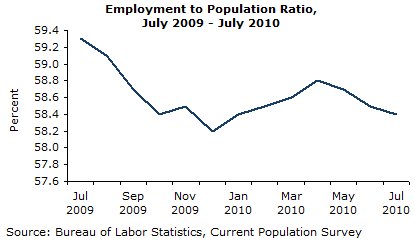
I have more bad news that probably won't surprise most BIDER readers but will at least shut up the shills who come here and try to tell us that college educated youth are doing a-okay at only 4 percent unemployment. I came across job data at the Center for Economic and Policy Research that shows African Americans and the college educated hit especially hard by job losses. Again, not surprising but here is the proof (emphasis mine):
African Americans were also hit especially hard. The EPOP for African Americans is back at its low point for the downturn and the EPOP for African American women hit a new low at 54.4 percent, 0.1 percentage points lower than the December ratio.

By education level, the less educated appear to be the big gainers, with a 1.8 percentage-point increase in the EPOP for those without a high school degree. Those with some college had a 0.8 percentage-point decline in their EPOP and those with college degrees had a 1.1 percentage-point drop to 72.7 percent, the lowest level of the downturn.

By age group, the big gainers continued to be the over-55 cohort, which added 54,000 jobs in July, bringing the 3-month gain to 182,000. Older women accounted for 167,000 of this rise in employment. By contrast, employment for women between the ages of 35-44 fell by 253,000 (1.8%) and for women between 45-54 by 186,000 (1.2%) since May.
There were substantial declines in all the measures of duration of unemployment. This likely reflects many long-term unemployed dropping out of the workforce after losing benefits. The percent of multiple jobholders dropped by 0.3 percentage points to the lowest on record. This presumably reflects difficulty in getting jobs.
Let me first say it amazes me that Washington does not seem to care enough to make drastic changes to stop the bleeding given that the current administration got into office riding on a huge wave of support from the young and minorities. The 22-year-old who voted in 2008 won't be the same voter in 2012 as a 26-year-old welfare recipient still unemployed four years after graduating from college with $100k loans. We are going to see that affect on the electorate in 2010 and 2012.

This doesn't mean life is good for the old and the uneducated, far from it, but it does point to a lack of real jobs with good wages and benefits being created. What kind of jobs do you think older women and high school drop outs are getting in this economy? Likely retail and restaurant work and a few manufacturing jobs that the majority of our college educated readership are considered overqualified for.

No one other than the political elite and the CEOs are coming out winners in this depression, but at least the uneducated have a better chance at the few service sector and manufacturing jobs. When there are no jobs, you have educated people willing to take practically anything for extra money to stay afloat even if it means driving a taxi or working at the shopping mall or grocery store.

Unfortunately for the damned generation, being educated is a curse because not only do you have student loans, you will be passed over for the less educated candidate for most of the new jobs created. Nearly every job I hear about on the local news is in the manufacturing or service industry. What are the chances that a 20-something female with a college degree and JD such as myself will get one of these $10-20/hour jobs over the recently laid off man with 20 years of experience on the factory line? Slim to none. That means the person with the $15 hourly job is still doing better, however small, than the unemployed JD or PhD making nothing to pay the rent and buy groceries.

In the end it is all about just hustling to survive and the 18 to 29 educated crowd clearly isn't doing well in that area. For example, I am single and have a current net worth of zero while the neighbor who bypassed college to get a masseuse certificate just bought a new house with her husband and has no student debt. Remind me again why I worked my ass off to get into the best schools?

Tuesday, August 10, 2010

Underemployment: 28.4% for Ages 18 to 29

Has anyone here been to a Third World Country?  I've traveled quite a bit before I hit rock bottom and one thing always struck me: Third World Countries represent Capitalism in its purist form.  If you're rich in Abu Dhabi, you're a king.  You're probably richer than God. If you are poor in India, you eat rats for dinner.  There are no boundaries to your wealth if you make it in a third world country.  Here, taxes will eat away at your earnings and you can't enslave people to serve your every need.  I guess you need to go to Mauritania for that.  That's against our social conscience here.

I firmly believe that India is not becoming more like America, but America is becoming New Bombay of the West.  So, long intro, but I just wanted to draw a comparison between something that has been a part of life in third world countries for a long time--and what is happening in our backyards.


When I was in Egypt with friends, we had an on-going joke.  Everyone that we ran across, the guy who sold meat on the street, the taxi driver, the man selling fruit on the street--they all claimed to be lawyers and doctors hard on their luck.  We naturally assumed they were full of shit.  It didn't make any sense to us.  Why would you be driving a cab if you were a lawyer or an engineer?  Why would you be selling me falafel if you were a doctor.  Not everyone can be so hard up, right?  Is it possible?

Even in my Third Country of origin, I have many cousins and second cousins who became extremely educated with B.S. degrees and Ph.Ds--only to sit home for years before securing a job.  My mother and I would tisk, tisk at them and question whether they did well in their programs or whether they were lazy in trying to get a job behind their backs.

So, now it's happening to us.  Can you believe that stat?  Nearly 1/3 of youth are underemployed.   With the cost of living at an all time high, that's essentially the same as being destitute.  It won't be long before your cabbie is a Harvard grad.

Americans aged 18 to 29 had easily the highest underemployment rate in July of any age group, at 28.4%, including 11.8% who were unemployed and 16.6% who were employed part time but wanted full-time work. Among all U.S. adults in the workforce, a higher percentage of women than of men are underemployed.
Yah. You don't have to tell me that more women are being affected than men.  I'm living it and I'm in the next age group.

I firmly believe, that a decent salary and benefits will not be forthcoming unless you make it happen yourself. In other words, in the years and decades to come, wealth in America will center around those who are born into it, and among large business owners.  Fewer and fewer companies will pay you a decent wage.  You will have to figure out a way to get it on your own.  When I graduated from law school, nothing was scarier than the thought of NOT having a regular paycheck.  I wish I wasn't raised to think of regular pay as a goal.  Maybe I would have been more enterprising.  Maybe you ought to be as well.  Invent your own way. If you see an opportunity, grab it.  Don't sit back and wait for anyone to hand you anything.  When the dust settles, I'm hoping that BIDER readers and I will come out unscathed.

I have a neighbor and, judging by his obliviousness, I'm positive that he will not read this.  Even if he does, he won't get my point.  He drives a beautiful car, a Z.  I love it.  He's in grad school.  He gave me a ride once and I asked him.... "You know, you're already driving a Z and you haven't graduated yet.  Where do you go from here?"

"I can't wait," he said.  There are no words.

Tuesday, July 27, 2010

The Globe and Mail Reports on "Broken Europe" and the Irish Exodus to Canada. What About "Broken" America?

funny pictures of cats with captions
Canada's Globe and Mail had an article last Friday about the Irish exodus to Canada as part of their series called "Broken Europe".

For biochemistry graduate Laura Cross, Tuesdays are special. She wakes early, wanders down to Arnotts department store on Henry Street, slips on her uniform and spends the day working in the underwear department.

One day a week fitting bras on plus-sized ladies is considered better-than-average work these days for an Irishwoman with an advanced degree and work experience; most of her fellow graduates can't even find that much.

The rest of the week, Ms. Cross, 23, waits for the dole cheque and reads up on the history and culture of British Columbia.

On Sept. 28, she will take the bus to the airport and fly to Vancouver, a work-study visa in hand and a number of job prospects in Canadian labs. Her boyfriend, a cabinetmaker who hasn't had work in two years, will join her in December.

Half a dozen of her friends and classmates are already there.

Sounds similar to the lives of most BIDER readers except better because she has a one day a week job and Ireland has a public health care system. I sympathize with Europeans who are experiencing high unemployment and no job prospects. But, being an American, I'm naturally most concerned with the plight of Americans including myself and my friends and family who are suffering because of the depression in the United States. The first thought that came into my head when I started reading this article was, how are thousands of Irish people able to go to Canada, yet, it is so difficult for Americans to live and work in Canada? I would like to know the number of Americans who have moved to Canada since the recession hit because if I could find a full time job in Canada or even temporary employment that would give me a work visa, I would accept without hesitation. Montreal, Toronto, Ottawa, Quebec City, Vancouver - I'd move to any one of those cities in a heartbeat. This article makes it seem like it's a piece of cake for anyone to abandon their home and move to Canada. I've been advocating leaving the country for months and even I know that it takes some time to work out the logistics, find a job abroad, and get a work visa.

On top of this, Ms. Cross is one of 2,500 young Irish people each year who are granted a work-travel visa; that number is capped but is "very heavily oversubscribed now," one official said. Before 2008, Irish visa applications fell below the quota.

A Canadian official said that the numbers for 2009 and the first half of 2010 are "much, much higher," though figures beyond 2008 are not yet available.

The new emigrants are either young and unemployed, like Ms. Cross, or they are older skilled workers with houses and established lives, who are abandoning it all in bankruptcy.

That describes electrician Gavin O'Brien, who left for Toronto this spring, abandoning his family house. In the peak of the boom, earning perhaps €150,000 a year in the overheated home-construction trade, he raised his mortgage payments to €3,000 a month in hopes of paying off the house within a few years: When the construction industry collapsed completely in 2008, the mortgage company refused to lower his payments. He offered to pay them €1,000 a month or to let them take the house, then got on a plane.

Canadians always laugh when I tell them that I need to find a Canadian man to marry so I can live in Canada. They often don't realize that I am dead serious. Five years ago when I was a naive college student who thought the world was my oyster, I would've told people that love conquers all. Now I tell people that Canadian citizenship conquers all. Ever since I was a little girl, I've been in love with Canada's natural beauty and multiculturalism. That they have national health care and is close to family and friends in the U.S. is are additional pluses. So, I'm not surprised that so many other people who are looking for better opportunities abroad are choosing to move to Canada.

I think Ms. Cross and any other young person who has the opportunity to immigrate to Canada is making the right decision to leave for greener pastures. Of course, her well-paid professors with secure jobs tried to dissuade her from leaving Ireland and to stay in school for as long as possible! That is probably the worst advice you can give to a young person. Take out more loans to stay in school and still end up unemployed and overqualified for the few entry-level jobs left out there. I really wish these professors would stop giving life advice as if they know anything about the job market outside of academia:

For young workers like Ms. Cross, the decision to migrate is less cataclysmic, but the choices are equally stark. "My professors were telling me that there was not going to be any work out there for a few years and we should just stay in school as long as we can," she said.

"But I decided to get out there and face the big bad world, and things are so bad that I just want to get up and get out, get away from all the difficulty. My sister's generation were probably the first one ever who could think of spending their whole life making a living in Ireland, but for the rest of us it's back to the old ways."

Have any of you considered finding work in Canada and what has been your experience thus far? I'm expecting that most of you will say it's nearly impossible to find a job in Canada right now. If any of you have found success in securing a visa to stay in Canada, please, do share.

Saturday, July 17, 2010

The Geography of a Recession


Doesn't the purple (10% or over unemployment) look like a disease consuming the entire nation? It's frightening to actually look at how much unemployment has grown across the country in the last two years.

In other news, I sprained my ankle while jogging. I don't know what I would've done if my injury had required surgery. Luckily it's not that serious. I went to the free clinic and the doctor said I should heal in a few weeks. That's what I get for trying to be physically active without any health insurance.

Wednesday, June 30, 2010

The Third Depression

I'm not sure how many of your caught this fascinating article by Paul Krugman about the third depression, in light of the G20 meetings of this past weekend.  It's not looking good, he says, and I would have to agree.
We are now, I fear, in the early stages of a third depression. It will probably look more like the Long Depression than the much more severe Great Depression. But the cost — to the world economy and, above all, to the millions of lives blighted by the absence of jobs — will nonetheless be immense.
There's good reason for that.  The leadership of the world has become overly concerned with inflation when the true fear should be deflation.  Every time the Federal Reserve meets to set the interest rates, I pray that they will increase interest, which will cause more people to save.  Instead, they are slashing it to record lows.
In 2008 and 2009, it seemed as if we might have learned from history. Unlike their predecessors, who raised interest rates in the face of financial crisis, the current leaders of the Federal Reserve and the European Central Bank slashed rates and moved to support credit markets. Unlike governments of the past, which tried to balance budgets in the face of a plunging economy, today’s governments allowed deficits to rise. And better policies helped the world avoid complete collapse: the recession brought on by the financial crisis arguably ended last summer. 
Once again, I call on King Clinton to save us from the our deficit.  Why do we learn about history only to shun its lessons when we need them?
Why the wrong turn in policy? The hard-liners often invoke the troubles facing Greece and other nations around the edges of Europe to justify their actions. And it’s true that bond investors have turned on governments with intractable deficits. But there is no evidence that short-run fiscal austerity in the face of a depressed economy reassures investors. On the contrary: Greece has agreed to harsh austerity, only to find its risk spreads growing ever wider; Ireland has imposed savage cuts in public spending, only to be treated by the markets as a worse risk than Spain, which has been far more reluctant to take the hard-liners’ medicine.
In short, yesterday's dip in the stock market--to below 10,000--will not likely be the last.  Nor will it be the lowest dip before this recession/depression is over.  And what does that mean to you?
And who will pay the price for this triumph of orthodoxy? The answer is, tens of millions of unemployed workers, many of whom will go jobless for years, and some of whom will never work again.
And this is true of everyone, not just lawyers.  So, put on your thinking cap and come up with a long term plan.  It seems that we will all be needing one.


Friday, May 21, 2010

Horror News Open Thread

Another day, another sign that the world is going to hell in a handbasket.

Let's start with the news that 300k teachers could be laid off this summer. Unlike overpaid law professors who fuck (literally) their students and contribute little to the well being of our society, teachers who work in primary, middle, and high schools are underpaid, overworked, yet are essential to an educated safe, and productive community. Schools in my area have already proposed 4-day school weeks and extended vacation. I expect the crime rate to skyrocket. When teenagers have nowhere to go because all of the schools and recreational facilities have been shut down, the only thing left to do is alcohol, drugs, sex, and loitering.

I've been putting off the BP Oil gusher spill because it's just too depressing beyond what we've all read and seen on the news and in photos. I recommend Naked Capitalism and Corrente for updated news and analysis of the cover-up story. Not only have wildlife and jobs been destroyed, but now there are reports that fishermen have become ill from BP's toxic chemicals while trying to clean up the spill.
More and more stories about sick fishermen are beginning to surface after the oil spill in the Gulf of Mexico.

The fishermen are working out in the Gulf -- many of them all day, every day -- to clean up the spill. They said they blame their ailments on the chemicals that BP is using.

One fisherman said he felt like he was going to die over the weekend.

"I've been coughing up stuff," Gary Burris said. "Your lungs fill up."Burris, a longtime fisherman who has worked across the Gulf Coast, said he woke up Sunday night feeling drugged and disoriented."

It was like sniffing gasoline or something, and my ears are still popping," Burris said. "I'm coughing up stuff. I feel real weak, tingling feelings.

"Marine toxicologist Riki Ott said the chemicals used by BP can wreak havoc on a person's body and even lead to death."

The volatile, organic carbons, they act like a narcotic on the brain," Ott said. "At high concentrations, what we learned in Exxon Valdez from carcasses of harbor seals and sea otters, it actually fried the brain, (and there were) brain lesions."
Despite the environmental disaster in the Gulf, Shell continues to go forth with plans to drill on the Alaskan coast as early as July 1st.

Do you have additional doomsday news to report? This is an open thread. Legal and non-legal news welcomed.

Saturday, April 10, 2010

Late Night Pessimism/Realism

For those of you who enjoyed Ian Welsh's last interview, here is another interview I came across on his blog today. Enjoy and sweet dreams.

Thursday, February 11, 2010

More Bad News: Unemployment Rate is Going to Remain High For a While

Read Dan Peck's article at the Atlantic titled, "How a New Jobless Era Will Transform America". That's right, folks. This is only the beginning of the jobless era, or what the New York Times columnist and economist Paul Krugman fears to be a lost decade, and it's gonna last for a long time. The first half of the article focuses on young people like us who are just beginning our careers or were laid off mid-career and whose lifetime earnings have been greatly diminished, as much as 25 percent in the first year of employment, compared to luckier graduates who get their jobs during boom times:


People who entered the workforce during the recession “didn’t switch jobs as much, and particularly for young workers, that’s how you increase wages,” Kahn told me. This behavior may have resulted from a lingering risk aversion, born of a tough start. But a lack of opportunities may have played a larger role, she said: when you’re forced to start work in a particularly low-level job or unsexy career, it’s easy for other employers to dismiss you as having low potential. Moving up, or moving on to something different and better, becomes more difficult.

“Graduates’ first jobs have an inordinate impact on their career path and [lifetime earnings],” wrote Austan Goolsbee, now a member of President Obama’s Council of Economic Advisers, in The New York Times in 2006. “People essentially cannot close the wage gap by working their way up the company hierarchy. While they may work their way up, the people who started above them do, too. They don’t catch up.” Recent research suggests that as much as two-thirds of real lifetime wage growth typically occurs in the first 10 years of a career. After that, as people start families and their career paths lengthen and solidify, jumping the tracks becomes harder.


Graduates in the unfortunate position of not being able to find work since they've left school understand that they are viewed as less marketable with every jobless month. You become so desperate that you apply to $10/hour jobs even when you're worth at least $30/hour in a good economy. If you're lucky enough to get a job with benefits you stay there for the next 5 years making $10-15/hour because the $30/hour job just isn't there. Your lifetime wage growth is thus completely ruined. You stay in your dead end administrative or temp job when you should really be making six figures at a larger corporation or firm, except now you're considered "overqualified" damaged goods. Your chances of getting the job you want is permanently destroyed. Unsurprisingly, this can lead to long lasting damage on one's mental and emotional health (let's not forget those six figure loans you took out to get a degree you thought would guarantee you a job that pays more than a fast-food worker).

Strong evidence suggests that people who don’t find solid roots in the job market within a year or two have a particularly hard time righting themselves. In part, that’s because many of them become different—and damaged—people. Krysia Mossakowski, a sociologist at the University of Miami, has found that in young adults, long bouts of unemployment provoke long-lasting changes in behavior and mental health. “Some people say, ‘Oh, well, they’re young, they’re in and out of the workforce, so unemployment shouldn’t matter much psychologically,’” Mossakowski told me. “But that isn’t true.”

Examining national longitudinal data, Mossakowski has found that people who were unemployed for long periods in their teens or early 20s are far more likely to develop a habit of heavy drinking (five or more drinks in one sitting) by the time they approach middle age. They are also more likely to develop depressive symptoms. Prior drinking behavior and psychological history do not explain these problems—they result from unemployment itself. And the problems are not limited to those who never find steady work; they show up quite strongly as well in people who are later working regularly.

The article goes on to discuss how this recession has affected graduates as well as lower-income families, minorities, and men laid off from their manufacturing jobs. I believe a significant percentage of our generation has been forever damaged by these lost years compounded by taking on thousands of dollars in debt because of misinformation about the value of higher education. The toll this recession will have on our own families when some of us have children while only just beginning our careers and paying off massive amounts of student loans is unthinkable. I also believe that the economic and social damage our children will have to fix will be a daunting task near impossible.

What is the solution? Even Krugman doesn't have an answer. This isn't just something we can fix in a few years and everything will be back to Clinton-era employment levels. Not. Gonna. Happen. This is only the beginning of a very long decline for the United States and we may never recover within the next two decades considering that the the two major political parties in Washington have no interest in real change to our nation's infrastructure, economy, education and health care system.

I'm sure many of you won't agree with me on this. My suggestion is if you don't want to spend the next 10-20 years unemployed or temping, learn a foreign language and a skill that is transferable anywhere in the world, then consider leaving the country if you can. If you refuse or can't because of family or financial reasons, be prepared to suffer for the foreseeable future. Hopefully some of you out there will have an idea to fix America or create a grassroots network of people in your community who will come up with solutions to local economic problems. But if you aren't willing to wait, the only solution I have is to marry a Canadian or someone from a country that will provide your children with better opportunities to obtain an affordable education and quality health care and leave until things get better. If anyone has better ideas feel free to list them in the comments below because I'd sure like to know how we can get out of this mess.

So, What's the Worst that Can Happen to Me?

A friend forwarded me this article to brighten my spirits, but it had the opposite effect.  Apparently, since Big Law associates are being deferred until 2012, contract attorneys will be leaned on more than ever.  As all my readers must know, being a contract attorney means that you have no stability and no benefits.  You are completely subject to the whim of a firm. You the modern day factory worker, much like Jurgis Rudkus from The Jungle.  You're nameless and faceless and often kept in the dungeons of the firm. 

But, I guess it's good news for people that don't mind living on the edge and people who never aspire to get hired again.  But, I'm not so sure I'm one of these people.  I guess I'm a bit of a control freak and document review is the antithesis of control.  You are told the rate at which to work, because you are given quotas.  You are also told the times at which you should work and how long your work week must be--both minimum and maximum hours.  You are also forced to take a lunch break on many projects.  So, because I don't think I'll get hired (and considering people are being deferred until 2012) I'm taking the plunge into the real "Deep End" and going solo, in an attempt to control my destiny ever so slightly.

So, as it stands, I'm attempting to supplement my document review with a solo practice until document review supplements a solo practice. There's no glory in this. It's what I have to do to stay pertinent to the current market. As I stated before, I'm pretty convinced that law firms will not be hiring full time employees with benefits anytime soon and I'll be damned if I sit there and hope for temp projects as they are slowly shipped to India. I have more pride than that.

So, the costs are mounting. I had to buy office supplies. A better printer with a scanner. A file cabinet will be next on the list.  I bought letterhead and business cards.  Hence far, the costs have been minimal.

But there's one hurdle that I need to jump--legal malpractice insurance.

I did a little search on-line and the costs were crazy... over $1000 a year with $5000 and $10000 deductibles.  So, I got in touch with someone that I knew through someone (I've been pushing that networking thing, Managing Partner)  And she had the best rate I have heard of hence far.... $900 a year! 

And she also went on to tell me that it goes up every year (one would think you'd be less of risk with more experience).

This brings me to my point... what is the worst that would happen?
 

Blog Template by YummyLolly.com - Header Image by Arpi